If you’ve ever typed “ChatGPT” into a search bar and then wondered what’s actually running under the hood, you’re not alone. “What programming language is AI coded in?” is one of the most common questions beginners, students, and curious professionals ask when they start exploring artificial intelligence.
The short answer: there isn’t just one. AI systems are built using a stack of programming languages, each doing a different job — from research and model training to the high-performance code that makes everything run fast. This guide breaks down exactly which languages power AI today, why Python leads the pack, and what you should learn if you want to build AI systems yourself.
Table of Contents
Key Takeaways
- AI is not built in a single programming language — it’s built with a combination of languages working together.
- Python is the dominant language for AI research, model development, and prototyping.
- C++, CUDA, and Rust handle the performance-critical layers that make AI fast at scale.
- JavaScript/TypeScript power the web interfaces most people use to interact with AI tools.
- Beginners should start with Python, then branch out based on the AI specialty they want to pursue.
Featured Snippet Answer: AI is not coded in one single language. Most AI systems are primarily built in Python for research, modeling, and development, with C++, CUDA, and Rust handling performance-critical components, and JavaScript or TypeScript powering user-facing interfaces.
What Is Artificial Intelligence?
Artificial Intelligence (AI) refers to computer systems designed to perform tasks that typically require human intelligence — things like recognizing images, understanding language, making predictions, or generating text. AI is a broad field that includes subfields like:
- Machine Learning (ML): systems that learn patterns from data rather than following fixed rules.
- Deep Learning: a type of ML that uses layered neural networks to handle complex tasks like image and speech recognition.
- Natural Language Processing (NLP): the branch of AI focused on understanding and generating human language, which is what powers chatbots and tools like ChatGPT.
AI isn’t a single piece of software — it’s an entire ecosystem of models, data pipelines, training infrastructure, and applications. That ecosystem is why no single programming language could realistically do the whole job.
Does AI Have One Programming Language?
No. This is one of the biggest misconceptions beginners have. AI development involves multiple languages, each chosen for a specific strength:
- Research and prototyping favor languages that are easy to read and quick to iterate in — this is where Python shines.
- Performance-critical operations (like running millions of calculations per second) need low-level languages like C++ or CUDA.
- Deploying AI to the web or mobile apps typically involves JavaScript, TypeScript, Swift, or Kotlin.
- Data infrastructure often relies on SQL and distributed systems tools.
Think of AI development like building a car. The engine (performance code) is engineered differently than the dashboard (user interface), even though both are part of the same vehicle. AI systems work the same way — different languages for different jobs, all working together.
Why Python Dominates AI
Python has become the default language for AI and machine learning development for several practical reasons:
Easy Syntax Python reads almost like plain English, which lowers the barrier to entry for beginners, mathematicians, and researchers who aren’t full-time software engineers.
Huge Community Because so many developers already use Python for AI, there’s an enormous amount of tutorials, forums, and open-source support available when you get stuck.
Libraries Python has mature, well-documented libraries for nearly every AI task — from data cleaning to neural network training — so developers rarely need to build tools from scratch.
Research Support Most academic AI research is published with Python code, which means new techniques become usable almost immediately after a paper is released.
Enterprise Adoption Major tech companies have standardized much of their AI tooling around Python, making it a safe long-term skill for developers entering the job market.
Top Programming Languages Used in AI
While Python leads, several other languages play important roles in the AI ecosystem depending on the use case.
| Language | Speed | Difficulty | Common AI Use Cases | Advantages | Disadvantages | Popular Frameworks |
|---|---|---|---|---|---|---|
| Python | Moderate | Easy | ML/DL research, prototyping, NLP, data science | Simple syntax, huge ecosystem, fast development | Slower raw execution speed | TensorFlow, PyTorch, Keras, Scikit-learn |
| Java | Fast | Moderate | Enterprise ML systems, big data pipelines | Portable, scalable, strong tooling | Verbose syntax | Deeplearning4j, Weka |
| C++ | Very Fast | Hard | Model inference, game AI, robotics, low-level ML libraries | High performance, fine-grained memory control | Steep learning curve | TensorFlow (backend), Caffe |
| R | Moderate | Moderate | Statistical modeling, data analysis, academic research | Excellent statistics libraries | Smaller AI-specific ecosystem than Python | caret, mlr3 |
| Julia | Fast | Moderate | Scientific computing, numerical ML | Combines speed with readable syntax | Smaller community | Flux.jl, MLJ.jl |
| JavaScript | Moderate | Easy | Browser-based AI, interactive demos | Runs directly in-browser, huge web ecosystem | Limited for heavy model training | TensorFlow.js, Brain.js |
| Lisp | Moderate | Hard | Historical AI research, symbolic reasoning | Strong for symbolic logic | Rarely used in modern AI | Common Lisp AI toolkits |
| Prolog | Moderate | Hard | Logic-based AI, expert systems | Excellent for rule-based reasoning | Niche, limited modern adoption | SWI-Prolog |
| Rust | Very Fast | Hard | High-performance AI infrastructure, safe systems programming | Memory safety with C++-level speed | Smaller AI library ecosystem | Candle, Burn |
| Go | Fast | Moderate | AI backend services, distributed systems | Simple concurrency, fast compilation | Limited native ML libraries | Gorgonia |
Pros & Cons Quick Reference
| Approach | Pros | Cons |
|---|---|---|
| Learning Python first | Fast start, most tutorials, broadest job demand | Not the fastest at runtime |
| Learning C++ first | Deep performance understanding | Slower learning curve for beginners |
| Learning JavaScript first | Immediate web deployment skills | Fewer dedicated AI research tools |
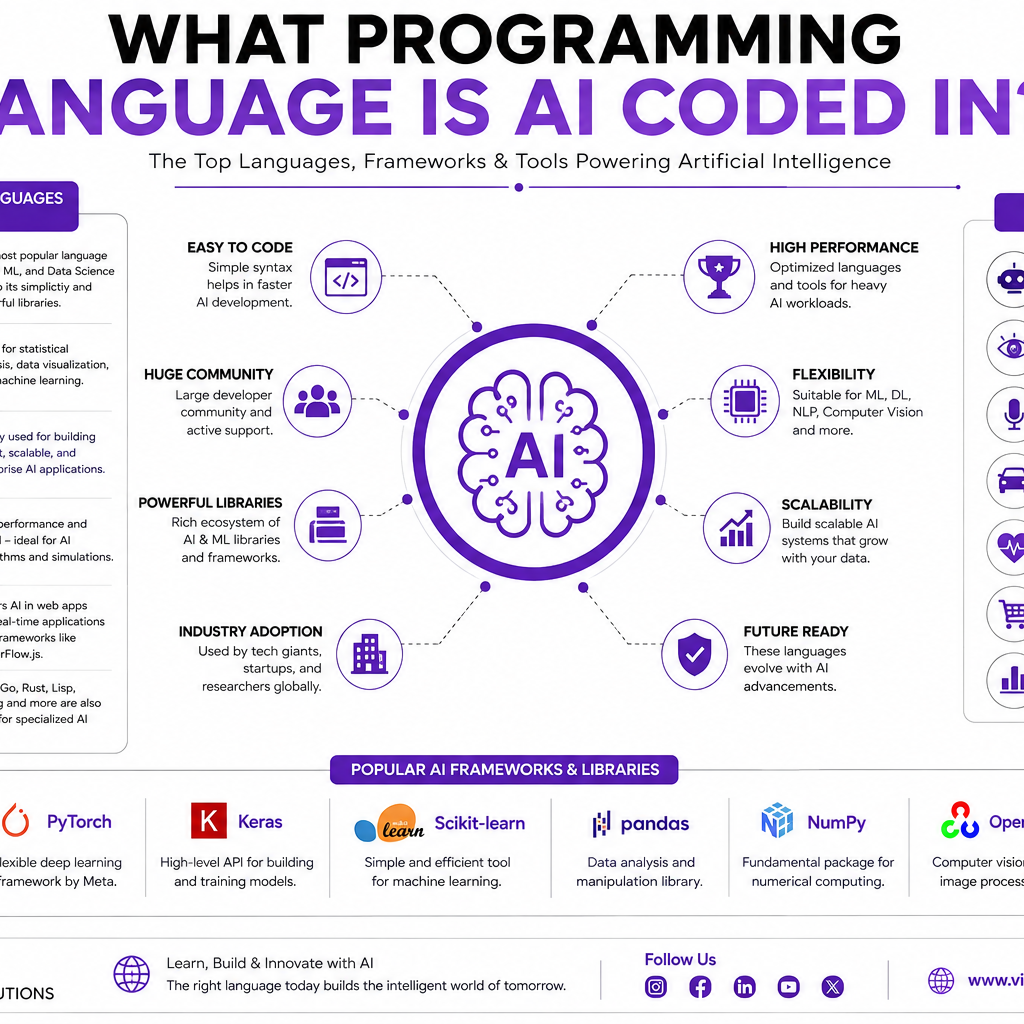
Why Python Is the #1 AI Language
Python’s dominance in AI comes largely from its library ecosystem. Here’s what each major tool is used for:
- TensorFlow — an open-source framework developed for building and training large-scale machine learning and deep learning models.
- PyTorch — a widely used deep learning framework known for its flexibility and popularity in research settings.
- Keras — a high-level API that simplifies building neural networks, often used on top of TensorFlow.
- NumPy — the foundational library for numerical computing in Python, used for handling arrays and matrices.
- Pandas — a data manipulation library used for cleaning, transforming, and analyzing structured data.
- Scikit-learn — a library offering simple, efficient tools for classical machine learning algorithms like regression and clustering.
- Hugging Face — a platform and library ecosystem widely used for accessing and fine-tuning pretrained language models.
These tools form the backbone of most AI projects today, and nearly all of them are Python-first.
Which Languages Are Used by ChatGPT and Similar Systems?
Modern conversational AI systems like ChatGPT are not built with a single language — they’re built in layers, and each layer typically uses a different tool suited to its job. It’s important to note that specific implementation details of proprietary systems are not publicly disclosed, but based on widely known industry practice, large-scale AI systems generally rely on a combination of the following:
- Python — used heavily for model development, training pipelines, and experimentation.
- C++ — used for performance-critical components, including parts of the underlying deep learning frameworks.
- CUDA — NVIDIA’s parallel computing platform, used to run computations efficiently on GPUs, which is essential for training and running large models.
- JavaScript / TypeScript — commonly used to build the web interfaces and applications that let users interact with AI models.
- Rust — increasingly used in modern AI infrastructure for its speed and memory safety.
- SQL — used for querying and managing structured data that feeds into AI systems.
- Bash — used for scripting, automation, and managing deployment pipelines.
- HTML/CSS — used to build and style the web interfaces AI products are delivered through.
This layered approach is standard across the AI industry — it’s not unique to any one company. Large models require research-friendly languages for development and low-level, high-performance languages for the infrastructure that runs them at scale.
AI Frameworks
Frameworks provide the building blocks developers use instead of writing everything from scratch:
- TensorFlow — an end-to-end platform for building and deploying machine learning models, widely used in both research and production.
- PyTorch — favored in research for its flexibility and dynamic computation graph, and increasingly used in production too.
- Keras — a beginner-friendly interface for building neural networks quickly.
- LangChain — a framework designed to help developers build applications powered by large language models, such as chatbots and AI agents.
- Hugging Face Transformers — a library that gives developers easy access to thousands of pretrained AI models.
- ONNX (Open Neural Network Exchange) — an open format that allows AI models to move between different frameworks and tools.
AI Libraries
Beyond frameworks, a handful of core Python libraries show up in almost every AI project:
- NumPy — handles fast numerical operations on arrays, forming the mathematical foundation many other libraries build on.
- Pandas — makes it easy to load, clean, and explore datasets before feeding them into a model.
- Matplotlib / Seaborn — used for visualizing data and model performance.
- Scikit-learn — a go-to toolkit for traditional machine learning tasks like classification and regression.
- OpenCV — widely used for computer vision tasks like image and video processing.
- NLTK / spaCy — used for natural language processing tasks such as text tokenization and parsing.
Should Beginners Learn Python?
Yes — for most people entering AI, Python is the most practical starting point. It has the gentlest learning curve, the largest support community, and the most direct path into using popular AI frameworks.
A Simple Beginner Roadmap:
- Learn Python fundamentals — variables, loops, functions, and basic data structures.
- Learn data handling — get comfortable with NumPy and Pandas.
- Study basic statistics and linear algebra — these underpin how machine learning actually works.
- Learn classical machine learning — start with Scikit-learn to understand regression, classification, and clustering.
- Move into deep learning — pick either TensorFlow or PyTorch and build small neural networks.
- Explore a specialty — computer vision, NLP, or reinforcement learning, depending on your interests.
- Learn deployment basics — understand how models get turned into usable applications, which is where languages like JavaScript or C++ may come in.
You don’t need to master every language on this list. Start with Python, build real projects, and expand your toolkit as your goals become clearer.
Future of AI Programming
AI development is evolving quickly, and the tools developers use are evolving with it:
- AI-Assisted Coding — developers increasingly use AI coding assistants to write, review, and debug code faster.
- Agentic AI — AI systems that can plan and execute multi-step tasks autonomously, often built using frameworks like LangChain.
- Multimodal AI — models that can process text, images, audio, and video together, rather than handling just one data type.
- Robotics — AI is increasingly paired with real-world hardware, often relying on languages like C++ and Python for control systems.
- Edge AI — running AI models directly on devices (phones, sensors, cameras) rather than in the cloud, which favors lightweight, efficient languages.
- Quantum AI — an emerging field exploring how quantum computing might accelerate certain AI computations, still largely in the research stage.
Common Myths About AI Programming Languages
Myth 1: “AI is coded in one language.” False. AI systems are built using multiple languages across research, infrastructure, and deployment layers.
Myth 2: “Python is too slow for real AI work.” Misleading. Python’s core libraries (like TensorFlow and PyTorch) are built on fast, compiled C++ and CUDA code underneath. Python acts as an easy-to-use interface on top of high-performance systems.
Myth 3: “You need to be a math genius to learn AI programming.” False. Basic statistics and linear algebra help, but most beginners learn the necessary math gradually as they build projects, rather than needing expertise upfront.
Myth 4: “JavaScript can’t be used for AI at all.” False. JavaScript has libraries like TensorFlow.js that allow AI models to run directly in the browser, though it’s less common for heavy model training.
Myth 5: “Learning one AI language is enough to work in the field long-term.” Not quite. While Python is the best starting point, professionals working in AI infrastructure, performance optimization, or deployment often need to learn additional languages like C++, Rust, or JavaScript over time.
Frequently Asked Questions
1. What programming language is AI coded in? AI is not coded in a single language. Python is the most common language for building and training AI models, while C++, CUDA, and Rust are commonly used for performance-critical components, and JavaScript/TypeScript are used for web-based interfaces.
2. What language is ChatGPT written in? Based on standard industry practice for large-scale AI systems, conversational AI tools like ChatGPT typically involve a combination of Python for model development, C++ and CUDA for performance, and JavaScript/TypeScript for user interfaces. Specific proprietary implementation details aren’t publicly disclosed.
3. Is Python enough for AI? Python is enough to get started and build most AI projects, especially with libraries like TensorFlow and PyTorch. However, professionals working on performance-critical systems often also learn C++ or Rust.
4. Which coding language should I learn for AI? Most beginners should start with Python due to its simple syntax and extensive AI library support.
5. Can AI be built with JavaScript? Yes, particularly for browser-based AI applications using libraries like TensorFlow.js, though it’s less common for large-scale model training.
6. What is the best programming language for machine learning? Python is widely considered the best language for machine learning due to its libraries like Scikit-learn, TensorFlow, and PyTorch.
7. What languages are used by major AI research labs? Most AI research labs primarily use Python for development, with C++ and CUDA used for performance optimization, following standard industry practice.
8. Do I need to know C++ for AI? Not necessarily as a beginner. C++ becomes more relevant if you move into performance optimization, robotics, or building AI infrastructure.
9. Is R still used in AI? Yes, particularly in statistics-heavy fields like academic research and data analysis, though Python has broader adoption for general AI development.
10. What is the difference between AI, machine learning, and deep learning? AI is the broad field of building intelligent systems. Machine learning is a subset of AI focused on learning from data. Deep learning is a subset of machine learning that uses layered neural networks for complex tasks.
11. How long does it take to learn AI programming as a beginner? This varies widely, but many beginners can build basic machine learning projects within a few months of consistent practice, starting with Python fundamentals.
12. What is CUDA and why does it matter for AI? CUDA is NVIDIA’s platform for running computations on GPUs, which significantly speeds up the training and running of large AI models.
13. Are AI frameworks free to use? Yes, most major AI frameworks like TensorFlow, PyTorch, and Hugging Face Transformers are open-source and free to use.
14. Can I build AI without knowing how to code? Some no-code AI tools exist for basic tasks, but building custom AI models still generally requires programming knowledge, most commonly in Python.
15. What should I learn after Python for AI development? After Python, many developers explore SQL for data handling, and later C++, Rust, or JavaScript depending on whether they focus on performance, infrastructure, or deployment.
Summary
AI isn’t built in one single programming language — it’s built with a coordinated stack of languages, each suited to a different part of the system. Python leads the way for research, modeling, and rapid development, while languages like C++, CUDA, and Rust handle performance, and JavaScript/TypeScript bring AI to the web. Understanding this layered approach gives you a realistic starting point for learning AI development yourself.
Ready to start learning AI programming? Begin with Python fundamentals, work through a few hands-on projects using libraries like NumPy and Scikit-learn, and gradually explore deep learning frameworks like TensorFlow or PyTorch as your confidence grows. Check out our related tutorials on Python for Beginners and Machine Learning Basics to keep building your skills.
Vivid Virtual Solutions
🌐 Website
▶️ YouTube
Add a Comment