Introduction
So, what is machine learning, really? If you’ve used a streaming app that recommends what to watch next, unlocked your phone with your face, or noticed suspicious emails automatically routed to spam, you’ve already experienced machine learning in action — even if nobody pointed it out at the time.
Machine learning is one of the most talked-about — and most misunderstood — topics in technology today. This guide breaks down what machine learning is, how it actually works, the different types of machine learning, real-world examples, and a practical roadmap for beginners who want to start learning it in 2026.
Table of Contents
What Is Machine Learning?
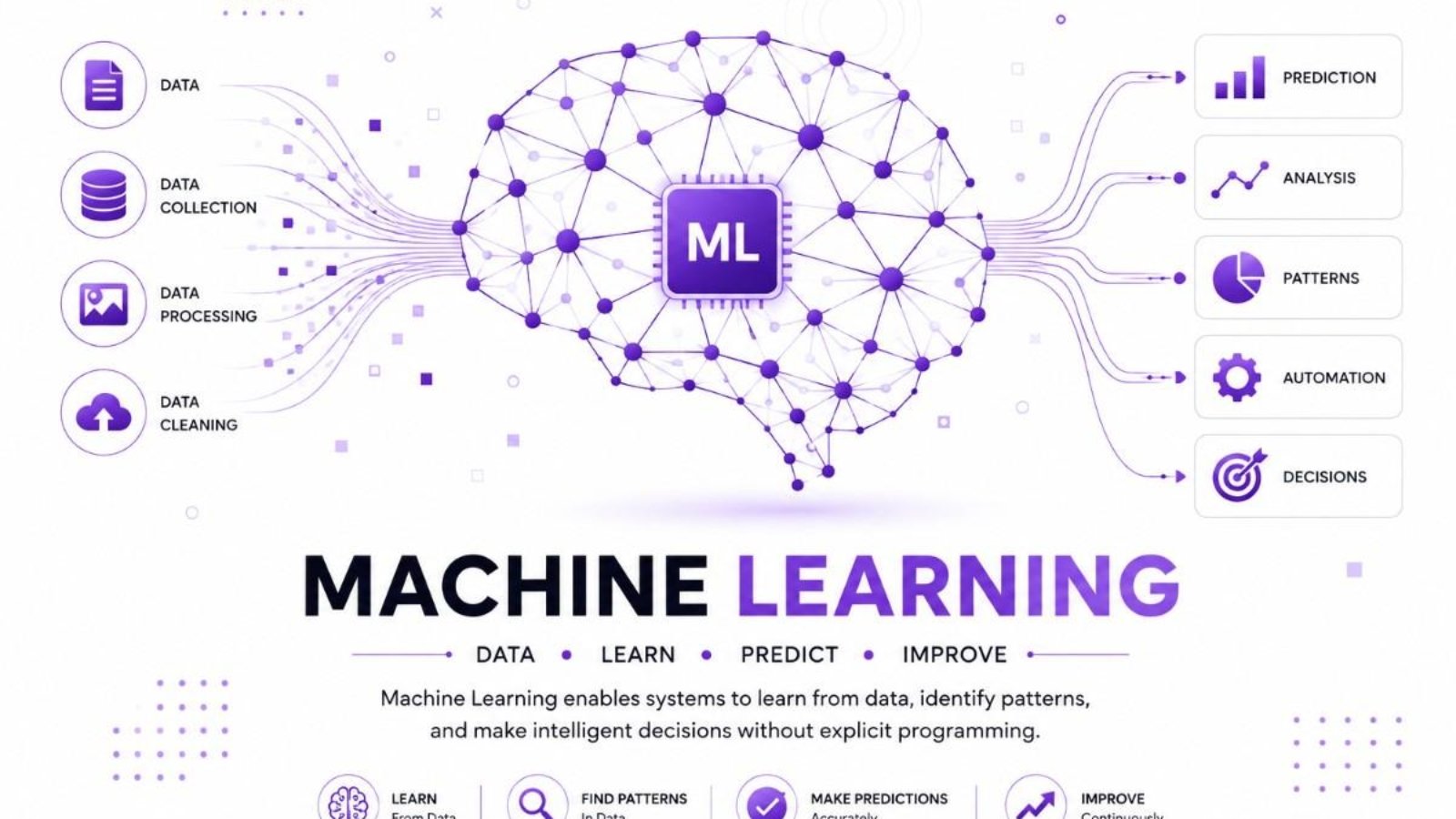
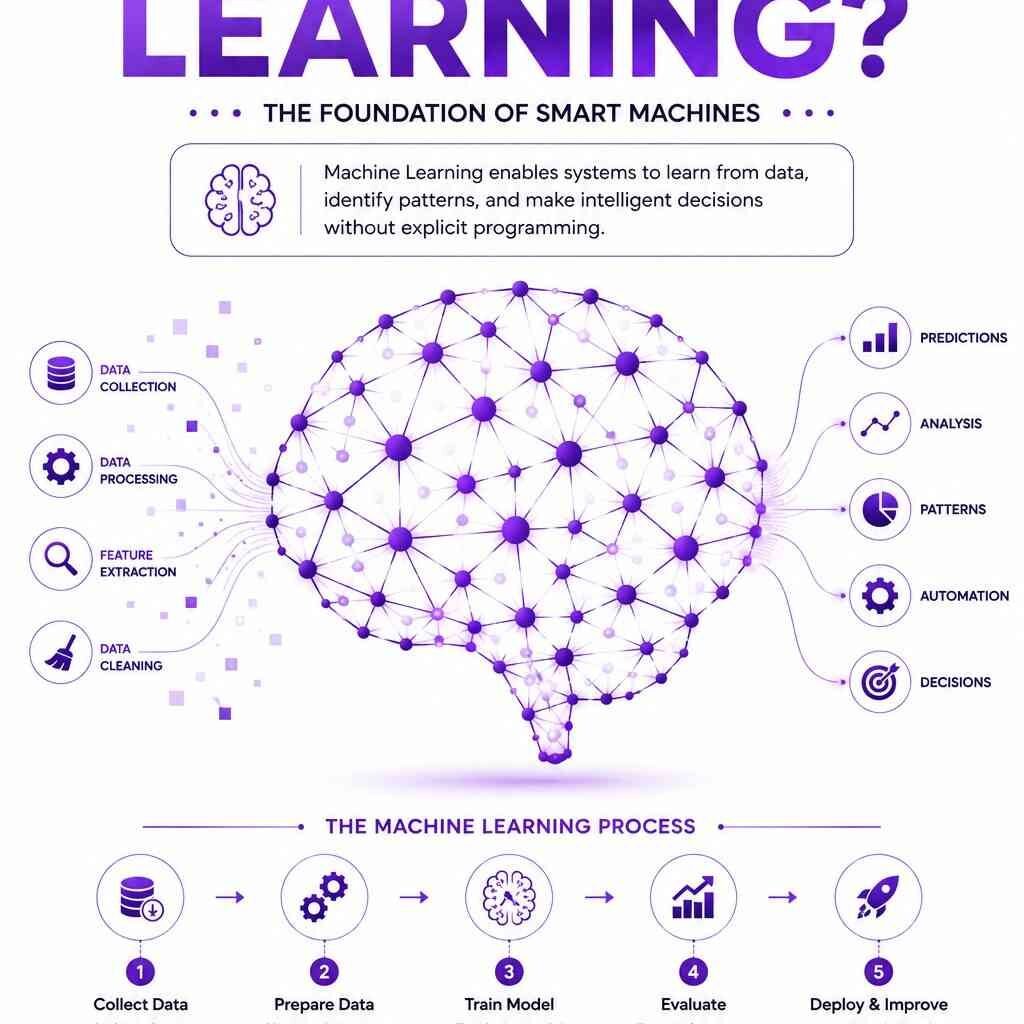
Machine learning is a branch of artificial intelligence (AI) that enables computers to learn from data and improve their performance on a task without being explicitly programmed with step-by-step instructions for every scenario.
In traditional programming, a developer writes fixed rules: if this happens, do that. Machine learning flips this approach. Instead of writing rules manually, developers feed a system large amounts of data, and the system identifies patterns on its own, which it then uses to make predictions or decisions on new, unseen data.
Quick Facts:
- Machine learning is a subset of artificial intelligence.
- It relies on data, statistics, and algorithms rather than hardcoded rules.
- It improves over time as it’s exposed to more data.
- It’s used across industries including healthcare, finance, retail, and entertainment.
History of Machine Learning
Machine learning didn’t appear overnight — it’s the result of decades of research in statistics, computer science, and mathematics.
| Era | Milestone |
|---|---|
| 1950s | Alan Turing proposes the concept of machines that can “learn” and introduces early ideas behind machine intelligence. |
| 1957 | The perceptron, an early neural network model, is developed, laying groundwork for future neural networks. |
| 1980s–1990s | Statistical learning methods and decision trees gain traction as computing power increases. |
| 1997 | IBM’s Deep Blue defeats a world chess champion, showcasing the power of algorithmic decision-making. |
| 2006 onward | Deep learning re-emerges as a major research focus, fueled by more data and stronger computing hardware. |
| 2010s | Machine learning becomes mainstream in consumer apps — recommendation engines, voice assistants, and image recognition. |
| 2020s | Large language models and generative AI bring machine learning into everyday conversation and daily tools. |
How Machine Learning Works
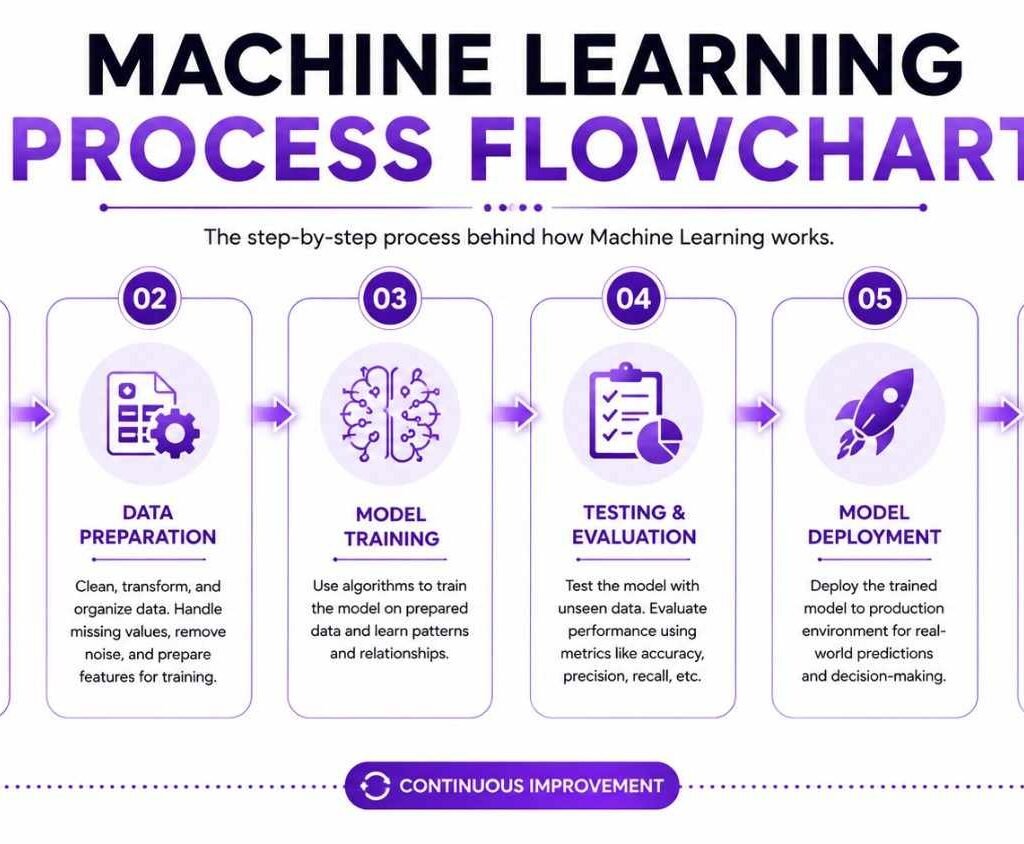
At a basic level, machine learning works by finding patterns in data and using those patterns to make predictions. Here’s the general idea, step by step:
- Data is collected — this could be images, text, numbers, or user behavior.
- Data is prepared — cleaned, organized, and split into training and testing sets.
- A model is trained — the algorithm studies the training data and adjusts itself to recognize patterns.
- The model is tested — it’s evaluated on new data it hasn’t seen before to check accuracy.
- The model is deployed — once it performs well, it’s used in real applications.
- The model is monitored and improved — performance is tracked over time, and the model is updated as needed.
Callout Box — Simple Analogy: Think of machine learning like teaching a child to recognize animals by showing them many pictures of cats and dogs, rather than describing every possible feature of a cat in words. Over time, the child (or model) learns to recognize the pattern on its own.
Machine Learning Workflow
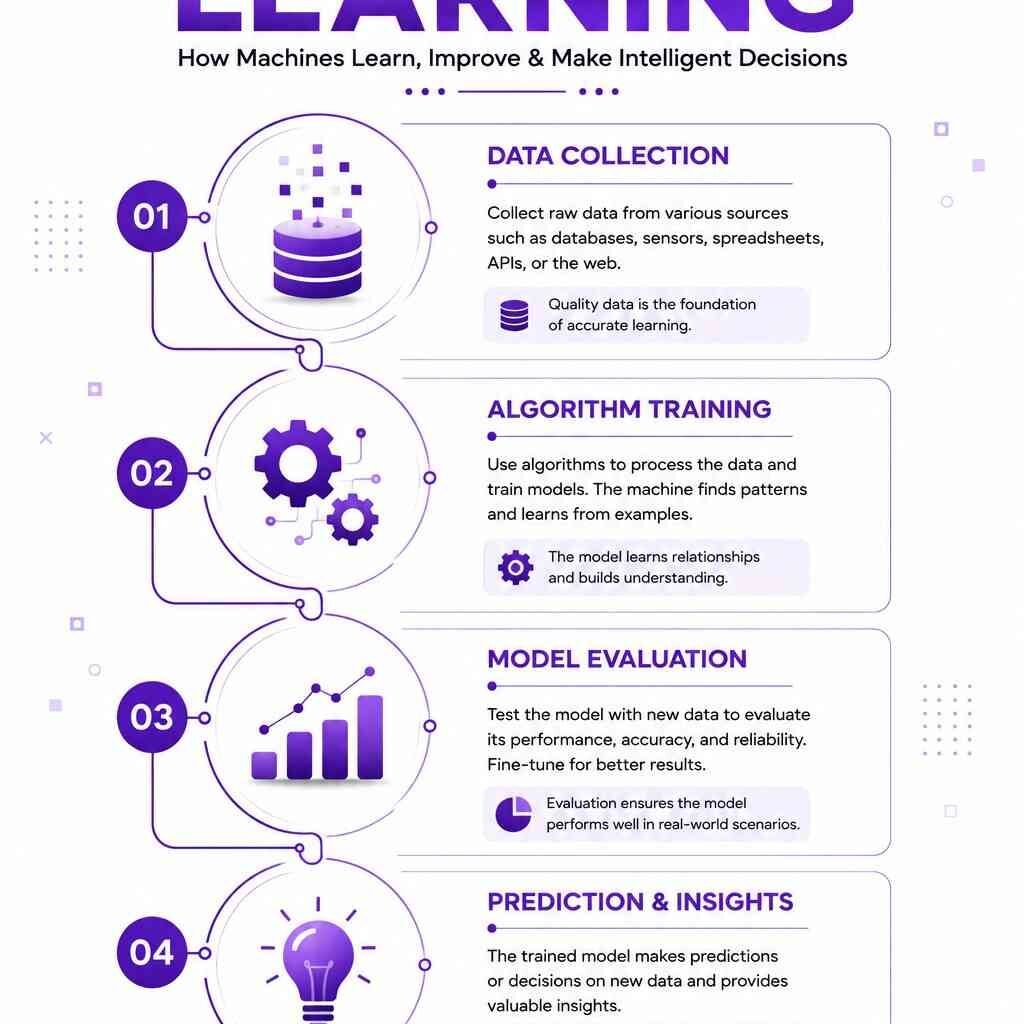
A typical machine learning workflow follows this structured process:
Step 1: Define the Problem Identify what you want the model to predict or classify.
Step 2: Collect Data Gather relevant, high-quality data related to the problem.
Step 3: Clean and Prepare Data Handle missing values, remove duplicates, and format data consistently.
Step 4: Choose an Algorithm Select a machine learning algorithm suited to the problem type (classification, regression, clustering, etc.).
Step 5: Train the Model Feed the training data into the algorithm so it can learn patterns.
Step 6: Evaluate the Model Test the model’s accuracy using data it hasn’t seen before.
Step 7: Tune and Optimize Adjust settings (called hyperparameters) to improve performance.
Step 8: Deploy the Model Integrate the trained model into a real application or system.
Step 9: Monitor Performance Continuously check how the model performs in the real world and retrain as needed.
Types of Machine Learning
There are four primary types of machine learning, each suited to different kinds of problems.
Supervised Learning
Supervised learning uses labeled data — meaning the data already includes the correct answer — to train a model. The model learns the relationship between inputs and known outputs, then applies that knowledge to new data.
Examples: Email spam detection, house price prediction, medical diagnosis support.
Unsupervised Learning
Unsupervised learning works with unlabeled data, meaning there are no predefined answers. The model looks for hidden patterns or groupings within the data on its own.
Examples: Customer segmentation, anomaly detection, market basket analysis.
Semi-Supervised Learning
Semi-supervised learning combines a small amount of labeled data with a larger amount of unlabeled data. This approach is useful when labeling data is expensive or time-consuming.
Examples: Medical image analysis where only some images are labeled by experts, large-scale text classification.
Reinforcement Learning
Reinforcement learning trains a model through trial and error, using a system of rewards and penalties. The model (often called an “agent”) learns to make decisions by interacting with an environment.
Examples: Game-playing AI, robotics, self-driving vehicle navigation systems.
Types of Machine Learning Comparison Table
| Type | Data Used | Goal | Common Examples |
|---|---|---|---|
| Supervised Learning | Labeled data | Predict outcomes based on known examples | Spam detection, price prediction |
| Unsupervised Learning | Unlabeled data | Discover hidden patterns or groupings | Customer segmentation |
| Semi-Supervised Learning | Mix of labeled and unlabeled data | Learn efficiently with limited labeled data | Medical image analysis |
| Reinforcement Learning | Feedback via rewards/penalties | Learn optimal actions through trial and error | Game AI, robotics |
Machine Learning Algorithms
Some of the most widely used machine learning algorithms include:
- Linear Regression — predicts continuous numerical values based on input variables.
- Logistic Regression — used for binary classification problems, like spam vs. not spam.
- Decision Trees — models decisions as a tree-like structure of choices and outcomes.
- Random Forest — combines multiple decision trees to improve accuracy and reduce overfitting.
- Support Vector Machines (SVM) — finds the optimal boundary to separate different classes of data.
- K-Nearest Neighbors (KNN) — classifies data points based on the closest labeled examples.
- K-Means Clustering — groups similar data points together without predefined labels.
- Neural Networks — layered models inspired loosely by the human brain, used heavily in deep learning.
Decision Tree Illustration (Described)
A decision tree can be visualized as a flowchart: starting from a root question (e.g., “Is the email from a known contact?”), branching into further yes/no questions, and ending at a final decision node (e.g., “Spam” or “Not Spam”).
Real-Life Examples
Machine learning already touches daily life in ways many people don’t notice:
- Email spam filters that learn to identify unwanted messages.
- Streaming recommendations on platforms that suggest movies or shows based on viewing history.
- Voice assistants that recognize speech and respond to commands.
- Facial recognition used to unlock smartphones.
- Fraud detection systems that flag unusual banking transactions.
- Navigation apps that predict traffic and suggest faster routes.
- Predictive text that suggests the next word while typing.
Machine Learning Applications
Machine learning is applied across nearly every industry:
Healthcare: Assisting with medical image analysis and predicting patient risk factors.
Finance: Detecting fraudulent transactions and assessing credit risk.
Retail: Powering product recommendation engines and demand forecasting.
Manufacturing: Predicting equipment maintenance needs before failures occur.
Transportation: Supporting route optimization and autonomous vehicle systems.
Marketing: Personalizing content and targeting based on user behavior patterns.
Cybersecurity: Identifying unusual network activity that may indicate a threat.
Machine Learning vs Artificial Intelligence
A common point of confusion is the difference between machine learning vs artificial intelligence. These terms are related but not interchangeable.
| Aspect | Artificial Intelligence | Machine Learning |
|---|---|---|
| Definition | The broad field of building systems that simulate human intelligence | A subset of AI focused specifically on learning from data |
| Scope | Includes reasoning, planning, robotics, ML, and more | Focused on pattern recognition and prediction from data |
| Example | A chatbot that can reason and plan multi-step tasks | A spam filter that learns from labeled email examples |
| Relationship | The umbrella category | One of several approaches used to build AI systems |
In short: all machine learning is artificial intelligence, but not all artificial intelligence is machine learning.
Machine Learning vs Deep Learning
Another frequent comparison is machine learning vs deep learning.
| Aspect | Machine Learning | Deep Learning |
|---|---|---|
| Data Requirements | Can work well with smaller datasets | Typically requires large datasets |
| Structure | Uses various algorithms (trees, regression, etc.) | Uses multi-layered neural networks |
| Feature Engineering | Often requires manual feature selection | Automatically learns features from raw data |
| Hardware Needs | Can run on standard hardware | Often requires GPUs for efficient training |
| Common Uses | Structured/tabular data problems | Image recognition, speech processing, NLP |
Deep learning is a specialized subset of machine learning, which itself is a subset of artificial intelligence.
Advantages and Disadvantages
Advantages
- Automates complex pattern recognition that would be difficult to code manually.
- Improves accuracy over time as more data becomes available.
- Scales well across large datasets and diverse applications.
- Enables personalization in products and services.
Disadvantages
- Requires large amounts of quality data to perform well.
- Can be computationally expensive, especially for deep learning models.
- Models can reflect biases present in training data.
- Results can be difficult to interpret, especially with complex models.
Pros & Cons Table
| Pros | Cons |
|---|---|
| Learns patterns automatically | Needs large, quality datasets |
| Improves with more data | Can be resource-intensive |
| Scales across industries | May inherit data bias |
| Enables personalization | Can lack transparency (“black box” models) |
Common Myths About Machine Learning
Myth 1: “Machine learning and AI are the same thing.” False. Machine learning is a subset of the broader field of artificial intelligence.
Myth 2: “Machine learning models are always 100% accurate.” False. All models have error rates and require ongoing evaluation and improvement.
Myth 3: “You need a PhD to learn machine learning.” False. While advanced research roles often require higher education, many practical ML skills can be learned through structured self-study and hands-on projects.
Myth 4: “Machine learning can think like a human.” False. Machine learning models identify statistical patterns; they don’t possess understanding or consciousness.
Myth 5: “More data always means a better model.” Misleading. Data quality and relevance matter as much as, or more than, sheer data volume.
Future of Machine Learning
Machine learning continues to evolve rapidly. Key trends shaping its future include:
- Automated Machine Learning (AutoML): tools that simplify model building for non-experts.
- Explainable AI: growing focus on making model decisions more transparent and interpretable.
- Edge Machine Learning: running models directly on devices like phones and sensors rather than in the cloud.
- Multimodal Models: systems that combine text, image, and audio understanding.
- Responsible AI Practices: increased emphasis on fairness, privacy, and reducing bias in ML systems.
Career Opportunities
Machine learning skills open doors to a range of career paths:
- Machine Learning Engineer — builds and deploys ML models into production systems.
- Data Scientist — analyzes data and builds models to extract insights.
- AI Research Scientist — develops new algorithms and techniques, often in academic or research settings.
- Data Analyst — works with data to support business decisions, often as a stepping stone toward ML roles.
- MLOps Engineer — focuses on the infrastructure and deployment pipelines for machine learning systems.
Learning Roadmap
Beginner Machine Learning Roadmap:
- Learn Python basics — variables, loops, functions, and data structures.
- Study basic statistics and probability — mean, variance, distributions, and probability theory.
- Learn linear algebra fundamentals — vectors, matrices, and matrix operations.
- Practice data handling — get comfortable with NumPy and Pandas.
- Learn classical machine learning — study Scikit-learn and core algorithms like regression and classification.
- Build small projects — apply what you’ve learned to real datasets.
- Explore deep learning basics — get introduced to neural networks using TensorFlow or PyTorch.
- Specialize — choose a focus area such as computer vision, NLP, or recommendation systems.
Beginner Checklist
- Learn Python fundamentals
- Understand basic statistics
- Learn NumPy and Pandas
- Complete one supervised learning project
- Complete one unsupervised learning project
- Learn model evaluation metrics
- Explore one deep learning framework
- Build a personal portfolio project
Best Resources to Learn Machine Learning
- Python official documentation — for mastering core Python syntax.
- Scikit-learn documentation — for learning classical machine learning algorithms.
- TensorFlow official guides — for deep learning fundamentals and tutorials.
- PyTorch official tutorials — for a research-friendly deep learning framework.
- Google’s Machine Learning resources — for structured, beginner-friendly learning paths.
- Microsoft Learn — for free, guided AI and ML learning modules.
- NVIDIA Deep Learning Institute — for GPU-accelerated machine learning training resources.
Frequently Asked Questions
1. What is machine learning in simple words? Machine learning is a way of teaching computers to recognize patterns in data and make predictions or decisions without being given exact step-by-step instructions for every scenario.
2. How does machine learning work? Machine learning works by training an algorithm on data so it can identify patterns, then using that trained model to make predictions on new, unseen data.
3. What are the main types of machine learning? The four main types are supervised learning, unsupervised learning, semi-supervised learning, and reinforcement learning.
4. What is supervised learning? Supervised learning is a type of machine learning that uses labeled data, where the correct answers are already known, to train a model to make predictions.
5. Machine learning vs artificial intelligence — what’s the difference? Artificial intelligence is the broad field of building intelligent systems, while machine learning is a specific subset of AI focused on learning from data.
6. What are some machine learning examples in real life? Common examples include spam filters, streaming recommendations, voice assistants, facial recognition, and fraud detection systems.
7. Is machine learning hard to learn? It has a learning curve, but with consistent practice — starting with Python and basic statistics — many beginners can build foundational skills within a few months.
8. What is the best way to learn machine learning? A structured approach works best: learn Python, study basic statistics, practice with real datasets, and gradually build projects using tools like Scikit-learn and TensorFlow.
9. What is a machine learning model? A machine learning model is the output of the training process — a system that has learned patterns from data and can make predictions on new data.
10. What is the difference between machine learning and deep learning? Deep learning is a specialized subset of machine learning that uses multi-layered neural networks and typically requires larger datasets and more computing power.
11. Do I need to know math for machine learning? Basic statistics, probability, and linear algebra are helpful, and most learners build this knowledge gradually alongside hands-on practice.
12. What programming language is best for machine learning? Python is the most widely used language for machine learning due to its simple syntax and strong library support, including Scikit-learn, TensorFlow, and PyTorch.
13. Can machine learning be used without coding? Some no-code and AutoML tools exist for basic use cases, but building custom models still generally requires programming knowledge.
14. What industries use machine learning the most? Machine learning is widely used in healthcare, finance, retail, manufacturing, transportation, and marketing, among many other industries.
15. What is reinforcement learning used for? Reinforcement learning is commonly used in robotics, game-playing AI, and systems that need to learn optimal actions through trial and error.
16. Is machine learning the same as data science? No. Data science is a broader field that includes data analysis, visualization, and statistics, while machine learning is one of the tools data scientists use to build predictive models.
Conclusion
So, what is machine learning? At its core, it’s a way of teaching computers to find patterns in data and use those patterns to make predictions or decisions — without needing every scenario explicitly programmed in advance. From spam filters to recommendation engines to fraud detection, machine learning already shapes much of daily digital life, and its role continues to expand across industries.
Whether you’re a complete beginner or exploring a career shift into tech, understanding machine learning fundamentals is a valuable and increasingly essential skill in 2026.
Call To Action
Ready to go deeper into AI and machine learning? Explore more beginner-friendly guides on Vivid Virtual Solutions, including our breakdowns of deep learning, generative AI, and programming languages used in AI development. Subscribe to our newsletter to get new tutorials delivered straight to your inbox, and don’t forget to share this guide if you found it helpful!
Add a Comment